This website uses Cookies. Click Accept to agree to our website's cookie use as described in our Privacy Policy. Click Preferences to customize your cookie settings.
Extensions
Turn on suggestions
Auto-suggest helps you quickly narrow down your search results by suggesting possible matches as you type.
- Community Home
- Platform
- Extensions
- Why does dynatrace shows 2x SQL Commit
Options
- Subscribe to RSS Feed
- Mark Topic as New
- Mark Topic as Read
- Pin this Topic for Current User
- Printer Friendly Page
Why does dynatrace shows 2x SQL Commit

Options
- Mark as New
- Subscribe to RSS Feed
- Permalink
05 Feb 2026 03:05 PM
Hi,
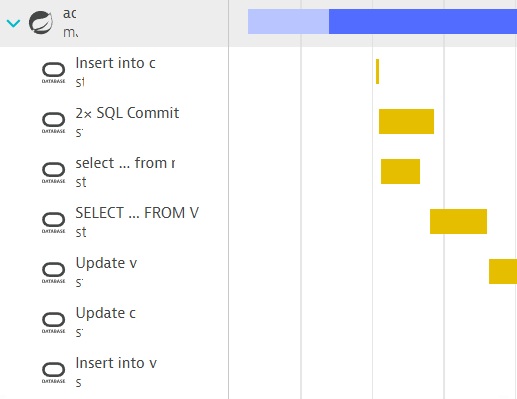
I am investigating a database issue where commit operations seem to take too much time.
My application creates two transactions. First, it starts the main transaction. Then it starts a second transaction, which commits after performing the first insert.
I am trying to understand why, in the distributed traces, I can see a double commit after the first insert, and why there is no commit shown after the second insert—where the main transaction should normally end and commit.
Labels:
- Labels:
-
databases
-
distributed tracing
-
oracle
-
sql
doublecommit.jpg
29 KB
1 REPLY 1

Options
- Mark as New
- Subscribe to RSS Feed
- Permalink
26 Feb 2026 01:17 PM
hi @danielkl,
Trying to summarize the understanding for the same.
1. Application Opens Two Transactions
If the application starts a main transaction and then a nested/secondary transaction, each performs its own COMMIT. Dynatrace detects both and aggregates them as 2× COMMIT when they occur consecutively.
2. Autocommit Enabled (DB Driver Behavior)
When autocommit is ON, the database driver may automatically commit after a statement, and the application framework may issue an explicit commit afterwards. This results in two commit operations showing as 2× in Dynatrace.
3. Connection Pool / Framework Commit-on-Close
Some frameworks perform a commit when commit() is called and again when the connection is closed or returned to the pool. Dynatrace identifies both operations and aggregates them.
4. Dynatrace Aggregation Logic
Dynatrace groups identical, consecutive SQL operations (such as repeated commits) for cleaner visualization, which is similar to how it aggregates repeated or identical queries in PurePaths.
The application may issue multiple COMMIT operations, and Dynatrace aggregates them into a single ‘2× COMMIT’ entry for clearer visualization.
Hope this helps you to understand.
Thanks
aravind

Featured Posts